Why look for another way to communicate?
Bitchat gained renewed popularity in France ahead of the October 2026 protests. Launched in 2025, this messaging application addresses a simple concern: how can people keep communicating when mobile networks cannot keep up? The press documented this renewed interest before the demonstrations on 24 October. Source: Le Monde, 23 October 2026.
To understand this need, consider a festival. Thousands of people in the same place try to share photos, call their families or find their friends. Their phones compete for the same radio resources. When demand exceeds available capacity, calls and data transfers may slow down or fail, even when the phone still shows a signal. To increase that capacity, Free deploys mobile base stations on trucks at major events. Source: Free, mobile connectivity at festivals.
New Year’s Eve illustrates the other dimension of the problem: demand concentrated in time. At midnight, almost everyone wants to send their greetings. For New Year 2026, Orange Belgium reported a peak of 1,315 text messages per second. Such a spike does not necessarily mean communication fails: a network provisioned to handle it can keep operating. At a festival or protest, the difficulty comes from combining both factors: many people in the same place at the same time. Source: Orange Belgium’s New Year traffic report.
Alongside possible congestion, there is another scenario: equipment failure. If mobile network equipment fails, calls, text messages or Internet access may be interrupted in the affected area. The result may look similar to the user, but the cause differs: in one case, the network lacks capacity; in the other, equipment has stopped working.
Such difficulties can also prompt suspicions of deliberate shutdowns, as in the context of the protests mentioned above. The sources consulted do not establish that the state cut mobile communications during these protests to disrupt them. A proposal to restrict social media, an outage and network congestion are three different situations. Without measurements or investigative evidence, I therefore cannot attribute a communication problem to an intention to shut down the network. Context: Le Parisien, 23 October 2026.
Visible interest, but difficult to measure precisely
This need for another way to communicate helps explain the interest in Bitchat. As of 29 October 2026, Bitchat’s Android listing on Google Play displays “1M+” downloads, indicating a threshold of at least one million downloads through that store. This cumulative figure is neither the number of active users nor a count of downloads in France or during the protests alone. It excludes iOS installations and other Android distribution channels. Google Play does not display an exact total here. Source: Google Play listing consulted on 29 October 2026.
How does Bitchat work without a mobile network?
Bitchat’s answer is to establish direct links between nearby phones using Bluetooth Low Energy. In this local mode, exchanges require neither a mobile network nor an Internet connection. The application discovers neighbouring devices and can have them relay messages: this is the principle of a mesh network. No phone number or central account is required. Official overview.
Imagine three people: phone A → phone B → phone C. A wants to send C a message, but their phones are too far apart to connect directly. If B can communicate with both, it can relay the message. All three devices must actually participate in the network: simply having phones nearby is not enough.
This relaying from one neighbour to the next is what makes the mesh useful. Bluetooth alone does not provide coverage across a city: communication depends on the participants available between sender and recipient.
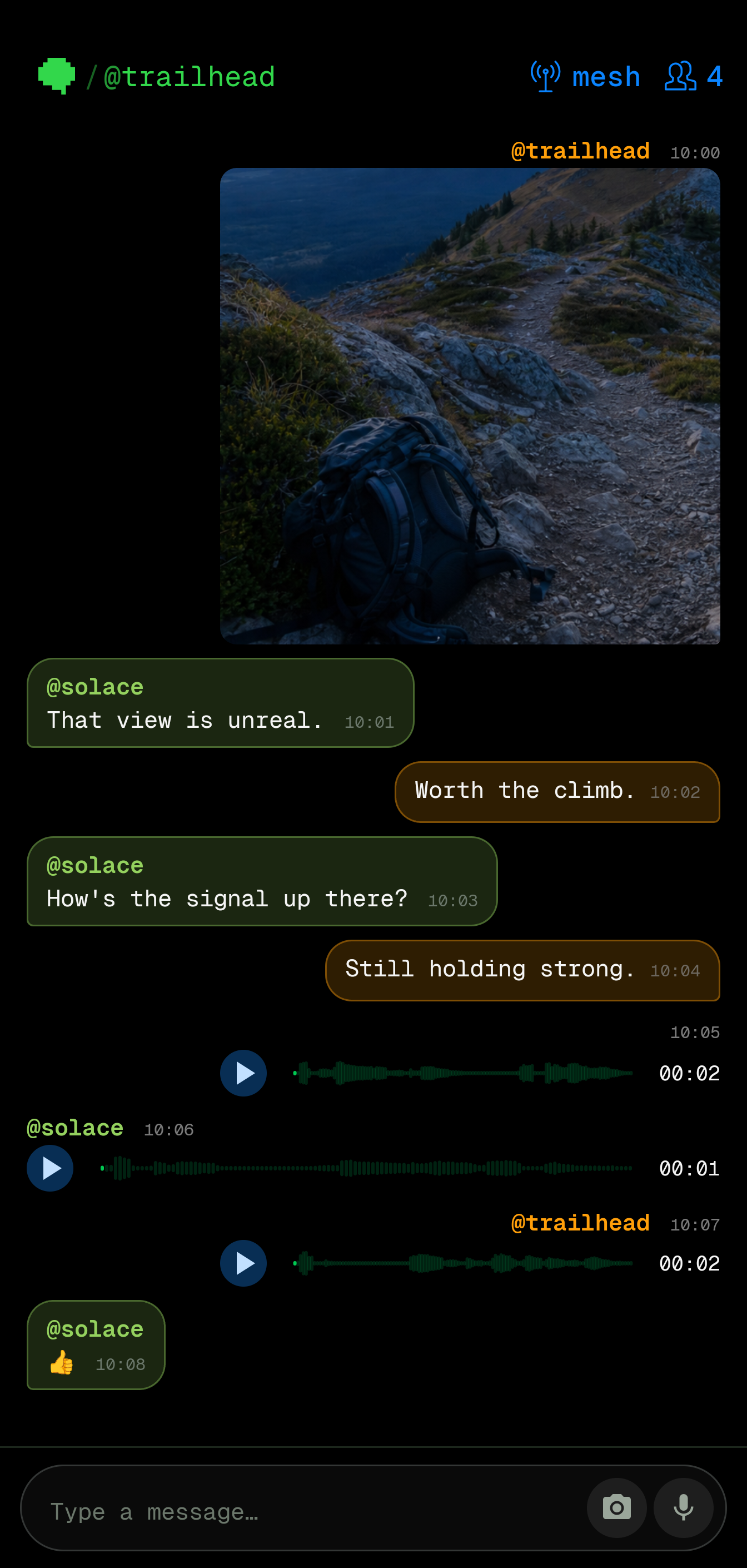
A mesh conversation on Android. Demonstration screenshot published in the official bitchat-android repository; the interface may vary by version.
Teleport: communicating beyond your immediate surroundings
Local operation naturally raises a question: how do you reach people further away? Bitchat offers another mode, with geographical channels identified by a geohash, a code representing an area. Teleport lets users select a distant channel. Someone can therefore participate in an area’s channel without being physically present there.
This change of scale requires different infrastructure: these channels use Nostr, a protocol relying on Internet relays. Tor can protect connections to these relays and hide the originating IP address from them. The two uses must therefore be distinguished: the Bluetooth mesh supports local exchanges without Internet access; Nostr channels support distant exchanges with Internet access.
Tor also depends on that connection. Teleport therefore cannot overcome a complete outage using Bluetooth alone. The privacy policy says Tor is enabled by default; check the setting in the version you use. Teleport implementation and privacy policy.
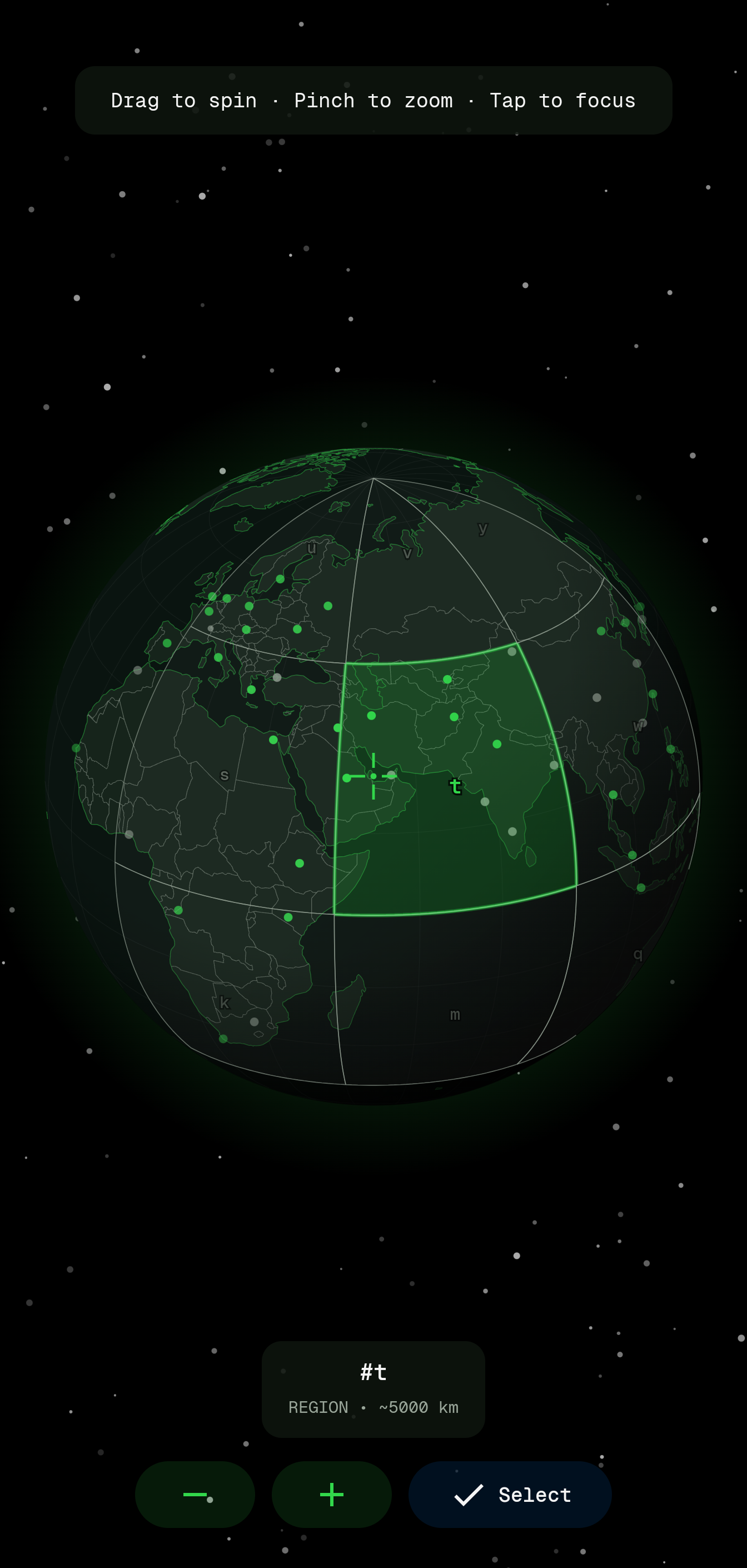
The geohash area selection globe on Android. The dimensions shown describe geographical areas, not Bluetooth range. Source: official bitchat-android repository.
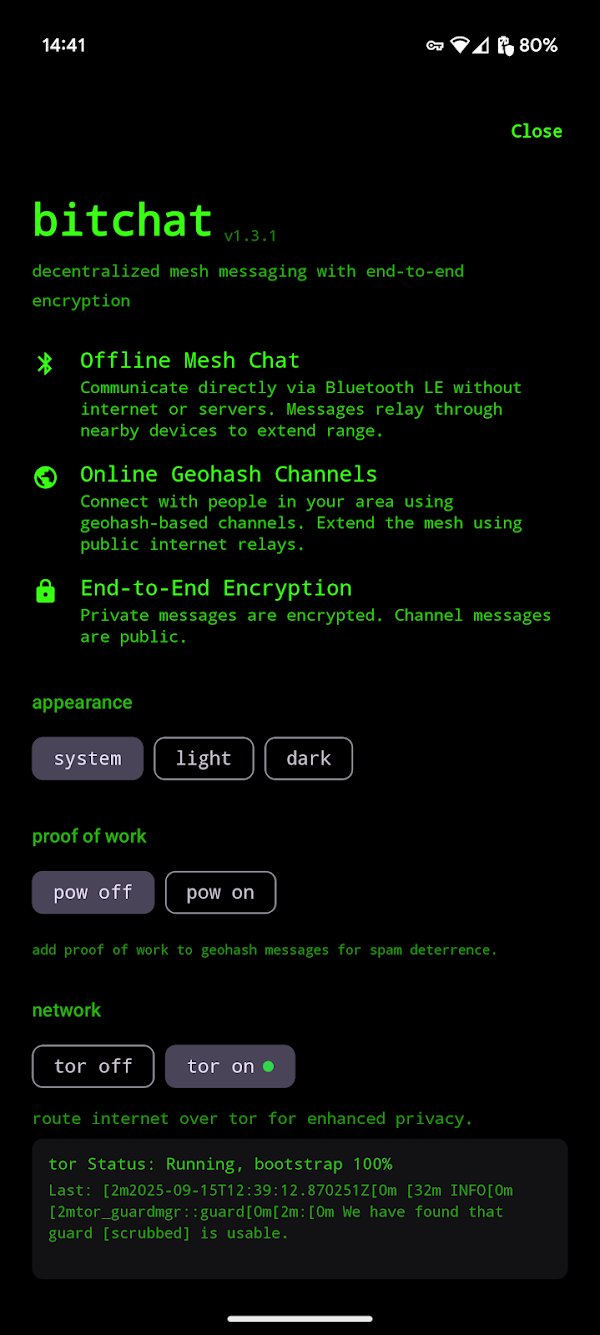
The overview screen and Tor settings on Android. Screenshot published on Google Play; it illustrates the version shown in the store and does not guarantee the settings of every installation.
How far can you actually communicate?
Let us return to the group without mobile network access. Installing the application is not enough to ensure a message arrives: there must be a path between phones. Several conditions come into play.
- Variable local range. Obstacles, interference, hardware and operating-system behaviour affect connections. An advertised distance is not a guarantee in the field.
- Relays are essential. Without a chain of participants, a later encounter or Internet access, two distant groups remain disconnected.
- A limited number of relays. TTL is a counter that limits a packet’s propagation through the network. The whitepaper documents an initial value of 7, which may be reduced in dense networks. Seven hops mean neither seven kilometres nor guaranteed delivery.
- Delivery may be delayed. Queues and devices carrying messages can enable later delivery. They do not create a continuous link.
TTL limits packet propagation; it must not be confused with how long a message is retained. Whitepaper, sections 4 and 6.
What does a chain of seven hops represent?
We can translate this mechanism into distance to understand its scale, provided the assumptions are explicit. Assuming 60 to 70 metres per link and a path of seven hops, the calculation is 7 × 60 to 70 m = 420 to 490 m, or approximately 400 to 500 metres.
This estimate assumes a chain of phones aligned towards the recipient, all available and suitably spaced. The calculation is illustrative: the documentation confirms an initial TTL of 7 but does not guarantee 60 to 70 metres per link. TTL alone therefore cannot establish a maximum distance. Obstacles, relay placement and propagation limits in dense networks can substantially reduce the actual distance covered. Android TTL constant and routing described in the whitepaper.
Who can read the messages?
The route a message takes determines how it travels. Whether it is public or private determines who can read its content. These are separate questions.
Public chat is intended to be read by its participants. Its content is not confidential: a signed message can be authenticated without being encrypted. Assume that a public message can be observed, copied and retained.
Private conversations use end-to-end encryption: intermediate relays carry encrypted data without needing to read the message. This does not protect against a recipient sharing the content or a compromised phone. Privacy policy, “Cryptography” and “What Is Shared” sections.
Which encryption protocol?
Encryption for live private sessions on the mesh network relies on the Noise XX protocol. It combines X25519 for key agreement, ChaCha20-Poly1305 for authenticated encryption and SHA-256 as a hash function.
Live Noise sessions provide forward secrecy: a later compromise of long-term keys should not be enough to decrypt past sessions. This property must not be extended to every mode. Noise protocol specification.
This distinction matters when a private message travels over Nostr. That route uses a Bitchat-specific format based on secp256k1, HKDF-SHA256 and XChaCha20-Poly1305. The documentation states that it is not compatible with NIP-17/NIP-44/NIP-59 and does not provide the same forward secrecy if the recipient’s private Nostr key is compromised. Technical whitepaper, section 5.
What traces remain after an exchange?
Knowing who can read a message is not enough to assess its confidentiality. We also need to ask where it is stored: encryption in transit does not mean the message disappears after being read.
On the sender’s and recipient’s phones, the Android code examined provides persistent private history in a SQLite database, with content encrypted using AES-GCM and a key managed by Android Keystore. Closing the application therefore does not erase these conversations. Android conversation storage and storage encryption.
Retention also supports delayed exchanges and synchronisation. On the sender’s phone and intermediate devices, the iOS/macOS documentation describes several mechanisms:
- An encrypted private outbox, retained for up to 24 hours without acknowledgement.
- Private envelopes carried by “courier” devices for up to 24 hours. These devices can relay the content without reading it.
- Public synchronisation history, retained for up to 6 hours. Its content remains public.
Sent or received images and voice notes can remain on those phones for up to seven days under this policy. These periods apply to the documented mechanisms and platform, not universally to every version. iOS/macOS retention policy.
Finally, Nostr Internet relays apply their own retention policies: their copies are outside the application’s control. Local deletion, including emergency wiping, does not remove copies held by recipients or these relays. Privacy policy, Nostr relays.
The opportunity: adding resilience
Once these conditions are understood, Bitchat’s value becomes more concrete. At the festival discussed earlier, a group already equipped with the application could keep exchanging local messages despite mobile network congestion, provided the necessary Bluetooth links and relays were available. This ability to maintain nearby communication when the mobile network is unavailable is what interests me: adding resilience to the usual means of communication.
The same reasoning can apply to a more serious situation. In a war context, such as Ukraine, a neighbourhood or group without network access might need to maintain local exchanges. This is a possible use case, not a claim of verified deployment in the field. Its usefulness would depend on participant density, available power and the threat level.
The opportunity therefore depends on preparation and local conditions. The decentralised model deserves examination, but it guarantees neither message delivery nor the safety of those using it. Beyond the technical limitations, trust in the exchanges still needs consideration.
Can you trust the exchanges and remain discreet?
Receiving a message does not guarantee its reliability. Open channels can attract spam, rumours or manipulation attempts. Blocking and abuse-limiting mechanisms provide protections without guaranteeing information quality. Cryptographic verification of a device does not certify its user’s real-world identity either.
Using a pseudonym does not guarantee discretion either. Not requiring a phone number or an account tied to a real name makes pseudonymous exchanges easier, while Bluetooth MAC address randomisation complicates tracking based on those addresses. However, persistent public keys and application identifiers remain observable on the mesh: they may allow a device to be recognised across appearances without automatically identifying its user. Private-message encryption therefore does not hide all metadata, meaning the information surrounding the exchanges. The traces retained on phones and relays, described above, must also be considered. Project privacy assessment.
These capabilities can also be misused. Like other communication tools, Bitchat could attract networks seeking to coordinate unlawful activities, particularly because its local operation is independent of mobile operators. This is a potential risk, not criminal use established by this article’s sources. The privacy limitations discussed above still apply to these users.
My conclusion
Bitchat offers a useful answer to part of the original problem: nearby phones can keep exchanging messages without a mobile network if the participants form a sufficient mesh. Communicating at a distance through Nostr channels and Teleport still requires Internet access.
For me, its value therefore lies in providing an additional communication method to explore and prepare before a crisis. People need to know whom they can reach, the conditions under which messages can travel and the traces they will leave. Range, relays and phone availability determine whether communication is possible; trust in other participants and metadata exposure shape how it should be used.
That is where I see the opportunity: giving a group an additional way to stay in contact. Message reliability, identity protection and independent security assessment will be decisive in evaluating what comes next.
Links and sources
Analysis written on 29 October 2026 using the sources consulted. Features and guarantees may vary by platform and version.